Cordavia Regular: Where Slab Serif Charm Meets Everyday Practicality
There's a particular kind of typeface that feels like a warm handshake—confident without being aggressive, stylish without trying too hard. Cordavia Regular sits squarely in that sweet spot. It's a slab serif with personality, the sort of font you notice on a coffee bag label or a boutique storefront and think, "That looks trustworthy." For designers, business owners, and anyone who cares about how words look on a page or screen, this typeface offers something genuinely useful: a blend of classic structure and approachable warmth that works across a surprising range of projects.
What Makes This Typeface Stand Out
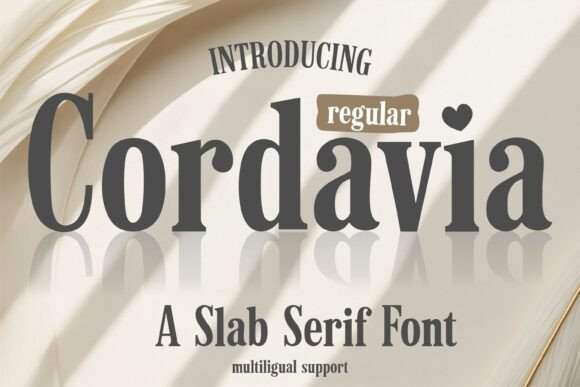
At first glance, Cordavia Regular reads as a traditional slab serif—strong, blocky terminals, sturdy verticals, and the kind of even weight distribution that keeps paragraphs legible at small sizes. Look closer, though, and you'll spot the details that give it character. The curves are softer than you'd expect from a slab serif, almost hand-drawn in places. There's a subtle vintage influence in the letter proportions, a nod to mid-century signage and packaging without veering into retro pastiche. And then there's the heart-shaped dot on the lowercase "i," a small touch that adds personality without overwhelming the design. It's the kind of detail that makes people smile when they notice it, and it's exactly the sort of thing that helps a brand feel human.
The font includes both uppercase and lowercase characters, numerals, essential punctuation, and full multilingual support. That last point matters more than many people realize. If you're building a brand that might eventually reach audiences in Western Europe, Scandinavia, or Latin America, you need a font that handles accented characters gracefully. Cordavia Regular does this without compromising its visual consistency, which is a genuine practical advantage.
Where This Font Actually Works
One of the best things about Cordavia Regular is its versatility. It's not a one-trick display font that only looks good at 72-point headline size. It holds up in body text, shines in logos, and carries enough visual weight to anchor packaging layouts. Here's where designers and business owners tend to find it most useful:
- Logo design and brand identity — The font's blend of strength and friendliness makes it a strong candidate for brands that want to feel established but approachable. Think artisan food companies, boutique retail shops, wellness brands, or creative studios.
- Packaging design — On labels, boxes, and bags, Cordavia Regular delivers the kind of shelf presence that helps products stand out. Its readability at medium sizes makes it practical for ingredient lists and product descriptions alongside bolder headline use.
- Merchandise and apparel — T-shirt designers often struggle to find fonts that look good on fabric without feeling generic. This typeface has enough personality to carry a design on its own, especially for inspirational quotes or brand slogans.
- Print materials — Posters, flyers, business cards, and invitations all benefit from a font that's both distinctive and legible. Cordavia Regular handles these formats well, whether it's set large for impact or smaller for supporting information.
- Digital projects — Website headers, blog graphics, social media posts, and email marketing templates all work nicely with this typeface. It renders cleanly on screens and pairs well with both serif and sans serif fonts for layered typographic systems.
- Editorial and publishing — Magazine layouts, book covers, and newsletter designs can use Cordavia Regular for pull quotes, chapter headings, or section titles where you want visual interest without sacrificing readability.
Crafters and hobbyists will also appreciate that the font works smoothly with popular design tools like Cricut, Silhouette, Canva, Procreate, Photoshop, and Illustrator. If you've ever bought a font only to discover it doesn't export cleanly to your cutting machine, you know how frustrating that can be. Cordavia Regular avoids those headaches.
Pairing It With Other Typefaces
No font exists in isolation. The real test of a typeface is how well it plays with others. Cordavia Regular's moderate personality means it won't clash with most companion fonts, but some pairings work better than others.
For a clean, modern look, try matching it with a geometric sans serif for body text. The contrast between the slab serif's texture and the sans serif's simplicity creates visual hierarchy without feeling disjointed. If you're going for something warmer, a humanist sans serif with slightly rounded forms will echo Cordavia's softer curves and create a cohesive, inviting feel.
Avoid pairing it with other heavily stylized fonts—a script typeface with lots of flourishes, for instance, can compete for attention and make layouts feel cluttered. The goal is contrast with harmony, not a typographic tug-of-war. When in doubt, set a test headline in Cordavia Regular and try two or three different body text options underneath. Read the combination at actual size, on the actual medium where it'll appear. What looks balanced on a large monitor might feel cramped on a phone screen or a printed business card.
Readability and Professional Polish
There's a common misconception that decorative or characterful fonts sacrifice readability. Cordavia Regular challenges that assumption. Its letter spacing is well-calibrated, the x-height is generous enough to keep lowercase letters legible at smaller sizes, and the serifs provide the kind of visual anchoring that helps readers track lines of text. This isn't a font you have to squint at.
That said, readability is always context-dependent. A font that reads beautifully in a 14-point paragraph on white paper might struggle as reversed-out white text on a dark background at 10 points. Always test your typography in the conditions where your audience will actually encounter it. Print a proof. View it on a phone. Ask someone who isn't a designer to read it and tell you if anything feels hard to parse. These small steps separate amateur layouts from professional ones.
Practical Considerations Before You Commit
A few things worth knowing before you start using Cordavia Regular in client work or commercial projects. First, the decorative swashes you might see in promotional images belong to the Cordavia Bold Swash style, not this regular weight. Cordavia Regular itself is clean and straightforward—no ornamental extras. That's actually an advantage for most professional applications, where clarity matters more than decoration.
Second, the font uses PUA encoding, which means all its characters and stylistic features are accessible through standard character maps in most design software. You won't need special plugins or workarounds to access every glyph. This is particularly helpful for people who work across multiple platforms or who collaborate with clients who use tools like Canva.
Third, always verify the licensing terms before using any font in commercial projects. Most premium fonts come with clear licensing for both personal and commercial use, but the specifics vary. If you're creating products for sale—whether that's printed merchandise, digital downloads, or client branding—make sure your license covers that use. It's a small step that protects you legally and supports the designers who create these tools.
Why Font Choice Matters More Than You Think
Typography is one of those design elements that people rarely notice when it's done well but immediately sense when something feels off. The fonts you choose for your brand, your products, or your content communicate before a single word is read. They signal professionalism, personality, and intentionality. A mismatched font can undermine an otherwise strong design. A well-chosen one—like Cordavia Regular for the right project—can elevate the entire visual experience.
For small business owners especially, investing in a quality typeface is one of the highest-impact, lowest-cost decisions you can make for your brand identity. It shows up everywhere: your website, your packaging, your social media, your invoices, your signage. Choosing a font that reflects your brand's personality and works reliably across all those touchpoints isn't just an aesthetic decision. It's a practical one that pays dividends in recognition, trust, and visual consistency over time.